
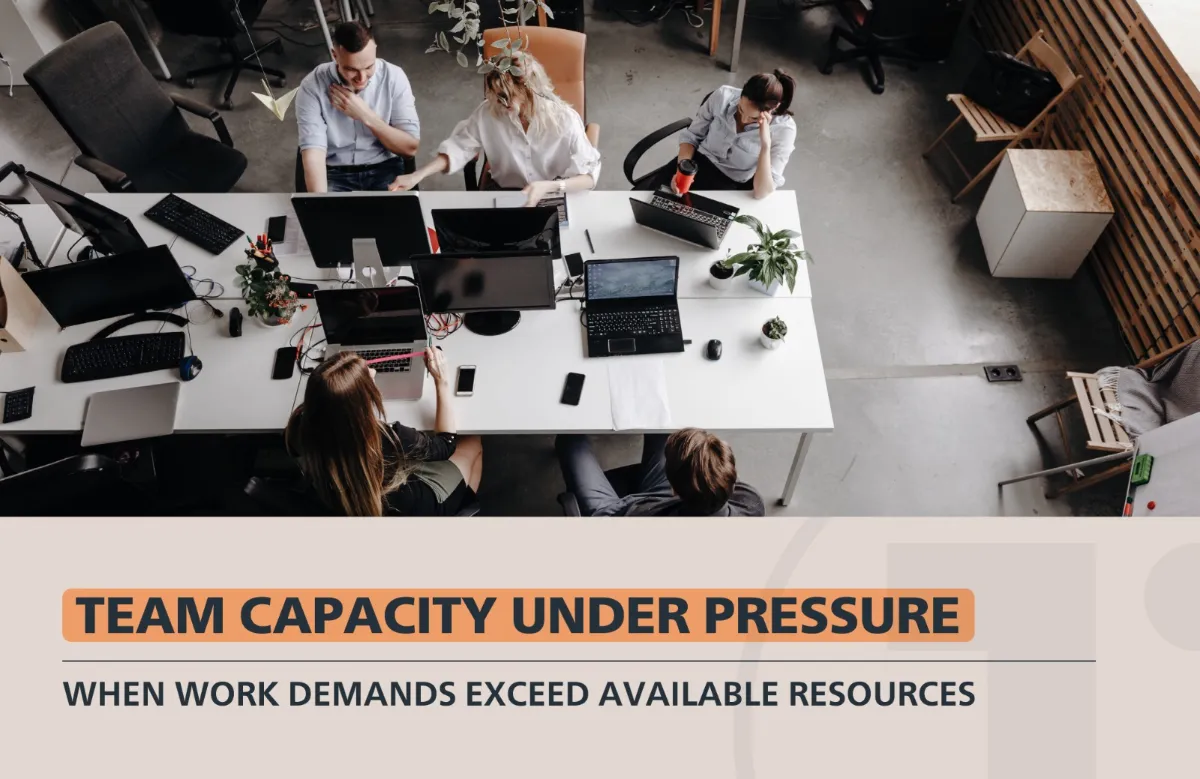
Team Capacity Under Pressure: When Work Demands Exceed Available Resources
Team burnout rarely happens overnight. More often, it develops gradually and can be difficult to notice at first. Workloads increase day by day, opportunities for recovery become fewer, and deadlines become progressively harder to meet.
By the time a manager recognises the full extent of the problem, employees may already be operating on their remaining reserves of energy simply to keep up with their responsibilities.
This is what makes burnout particularly difficult to identify in its early stages. An employee may still complete tasks, attend meetings and appear to be functioning as usual. Beneath the surface, however, their energy and engagement may be steadily declining. Over time, this can begin to affect productivity, the quality of work and interpersonal relationships within the team.
To understand whether employees are working within realistic expectations, managers first need clarity around the responsibilities attached to each role. Job analysis and job description development provide an important foundation for this, as unclear or overlapping responsibilities can become a significant source of unnecessary pressure, frustration and disengagement.
In this article, we explore the early signs of employee burnout, how individual exhaustion can affect the wider team, and the practical steps managers can take before the problem becomes more serious.
What Is Burnout?
The World Health Organization (WHO) includes burnout in the International Classification of Diseases (ICD-11) as an occupational phenomenon. It is not classified as a medical condition. WHO defines burnout as a syndrome resulting from chronic workplace stress that has not been successfully managed.
According to WHO, burnout is characterised by three main dimensions:
- Energy depletion or exhaustion - a persistent sense of having little physical or emotional energy available for work.
- Increased mental distance from one’s job, which may appear as detachment, negativity or cynicism towards work.
- Reduced professional efficacy - a decline in an employee’s sense of effectiveness and ability to perform their role successfully.
These dimensions help distinguish burnout from ordinary, temporary tiredness. A demanding week or a particularly intense project may leave an employee exhausted, but burnout reflects a more persistent pattern associated with chronic workplace stress.
WHO also emphasises that the term burnout applies specifically to the occupational context and should not be used to describe stress or exhaustion arising from other areas of life.
Early Signs of Burnout on individual level
Recognising an employee who may be approaching burnout often begins with noticing relatively small changes in behaviour.
Someone who was previously proactive and engaged may gradually become more passive. They may contribute less during meetings, ask fewer questions or become reluctant to participate in new initiatives.
Another possible sign is increased irritability or tension that appears out of character. At the same time, mistakes may become more frequent as sustained fatigue makes concentration more difficult. This can be particularly visible in roles where attention to detail, sound judgement and a high level of responsibility are essential.
Tasks that were once routine may also begin to require considerably more effort.
A further warning sign can be psychological withdrawal from work. The employee may continue to attend work and meet basic requirements, but their involvement becomes increasingly mechanical. Rather than contributing ideas or taking initiative, they focus primarily on completing the minimum necessary tasks.
If this pattern continues, disengagement can deepen and the employee may gradually lose the sense of connection and purpose they previously associated with their work.
When Individual Burnout Begins to Affect the Whole Team
Burnout does not necessarily remain an individual issue. When several employees experience prolonged workplace pressure, the effects can begin to influence team dynamics, operational performance and the wider organisational environment.
One pattern managers may notice is an increase in absence or unplanned time away from work. Absenteeism can have many causes and should not automatically be attributed to burnout. However, when it rises alongside other signs of prolonged pressure and exhaustion, it may indicate a broader issue that deserves closer attention.
A further warning sign is increasing employee turnover. When workplace pressure becomes difficult to sustain, some employees may begin looking for opportunities elsewhere. If this trend is not addressed, the organisation risks losing experienced people whose knowledge and expertise may be difficult and costly to replace.
Recruiting, onboarding and integrating new employees then places additional demands on the colleagues who remain, potentially increasing pressure on a team that is already operating with limited capacity.
The wider atmosphere within the organisation can change as well. Motivation declines, new ideas become less frequent and routine tasks begin to take longer than usual. Misunderstandings and conflicts may also increase, as people experiencing prolonged fatigue often have less energy available for collaboration and communication.
At this stage, well-designed business process management can help reduce unnecessary operational pressure by clarifying workflows, eliminating duplicated tasks and creating greater consistency across the organisation.
What Causes Employee Burnout?
Burnout is rarely the result of a single factor. It tends to develop when workplace demands remain high over an extended period without sufficient resources, support or opportunities for recovery.
Working time is one important part of this equation. The International Labour Organization (ILO) highlights excessive working hours and inadequate periods of rest and recuperation as important occupational health and safety concerns. Long working hours can contribute to fatigue, sleep disruption and reduced well-being, particularly when employees have insufficient time to recover between working periods.
International labour standards have historically used 48 hours per week as an upper limit for normal working hours, while encouraging the progressive reduction of normal working time towards 40 hours where appropriate. The underlying principle is not simply to count hours, but to protect employees from excessive fatigue and ensure adequate opportunities for rest and recovery.
The quality of recovery matters just as much as the number of hours worked. When employees remain mentally connected to work throughout evenings, weekends or other non-working periods, genuine recovery becomes more difficult.
A long-term HR strategy can help organisations address these risks more systematically by aligning workforce capacity, responsibilities and resources with realistic business demands.
The ILO also emphasises the importance of adequate rest between working periods. When long working days and insufficient recovery are repeated over time, fatigue can accumulate rather than disappear from one day to the next.
For this reason, assessing workload should involve more than counting the number of tasks assigned to employees. Organisations also need to consider how work is distributed, how consistently high-pressure periods occur, whether deadlines are realistic and whether employees have sufficient opportunities to recover.
How to Prevent Team Burnout
Effective prevention begins with understanding what is actually happening within the organisation.
Managers do not always have full visibility into how employees are experiencing their work. Periodic employee surveys, structured feedback mechanisms and regular conversations can help organisations identify emerging patterns before they become serious problems.
But identifying the problem is only the first step. The organisation must then be prepared to address the underlying causes — whether these involve unrealistic workloads, unclear responsibilities, inefficient processes, insufficient staffing, weak managerial support or persistent communication problems.
Building team capability is also important. In the longer term, learning and development can strengthen employees’ professional skills and help them approach increasingly complex responsibilities with greater confidence.
At the same time, development initiatives should complement , rather than replace, realistic workload planning and healthy working practices. Employees cannot simply be trained to cope with structurally unsustainable demands.
Initiatives such as team building can also support communication, trust and stronger working relationships within a team. However, their greatest value comes when they form part of a broader organisational approach that also addresses the underlying sources of workplace pressure.
How One Point Supports Companies
Preventing burnout requires ongoing attention to how people experience work and how effectively the organisation itself is functioning. This can be particularly challenging for companies with limited internal HR capacity.
Once risks are identified, organisations also need the expertise and resources to translate those findings into meaningful action.
One Point helps companies understand how work is actually organised, identify systemic issues and develop practical measures to address risks before they become more serious.
Through professional HR support, organisations can build healthier and more sustainable working environments - where clear roles, effective processes and realistic expectations allow employees to remain productive, engaged and motivated without prolonged pressure becoming the norm.