
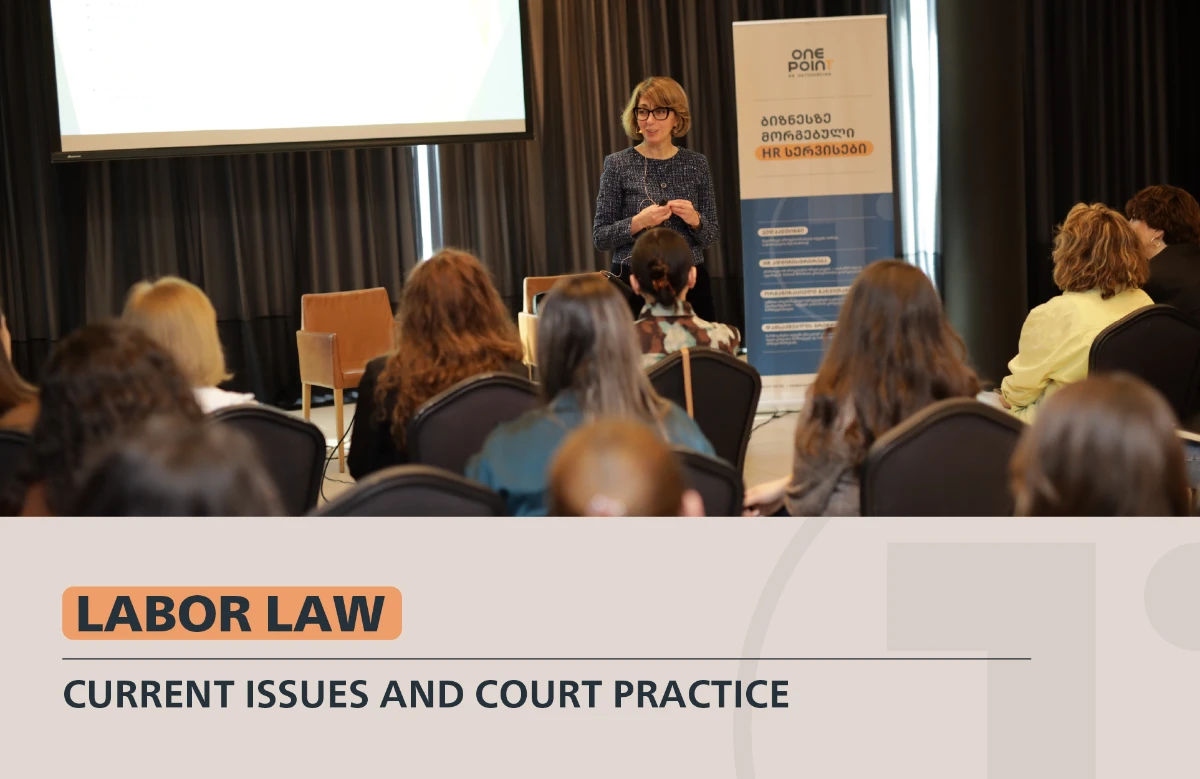
Labor Law – Current Issues and Court Practice
Poorly managed employment law processes can expose an organization to significant financial and reputational risk.
Court practice clearly shows that the majority of labor disputes stem from a handful of recurring causes: incorrectly classified contracts, procedural errors at the point of termination, and discrimination claims.
Preventing all of this requires HR professionals, lawyers, and company managers to have solid legal knowledge and practical judgment, allowing them to make well-informed decisions.
From Theory to Practice
On March 21, 2026, the HR outsourcing company One Point organized a hands-on training session titled "Labor Law: Current Issues and Court Practice," bringing together representatives from across sectors – HR managers, lawyers, and business leaders – under one roof.
Below are the key topics covered during the training, along with takeaways from court practice and recommendations to help companies prevent legal risk.
Correct Classification of Contracts
Employment contracts, contractor agreements, and service contracts often look alike on paper, yet their legal nature differs considerably.
Court practice shows that what matters is not the name given to a contract, but the actual relationship between the parties.
Misclassifying these contracts increases the likelihood of disputes, financial losses, and reputational damage.
Practical recommendations for HR:
- The type of contract should be assessed in advance, taking into account both the legal reality and the nature of the working relationship.
- Existing contracts should be reviewed periodically.
Managing the Full Employment Lifecycle
Every stage of the employment relationship – hiring, day-to-day management, and termination – is subject to legal requirements. A mistake at any stage can escalate into a court dispute.
Unlawful Dismissal: Legal Consequences
Dismissal is one of the most common sources of litigation. When a court rules that a dismissal was unlawful, the employer faces the following obligations and risks:
- Annulment of the dismissal order
- An obligation to pay forced leave compensation
- An obligation to pay damages
- Reinstatement of the employee or placement in an equivalent position
Such disputes frequently drive up costs and have a negative impact on the company's reputation.
Practical recommendations for HR:
Every dismissal should be assessed from a legal standpoint before a decision is made. Consulting the company's lawyer ahead of time is an investment - and an important step toward preventing risk.
Non-Compete Provisions
In today's business environment, mechanisms for restricting competition are becoming increasingly relevant, particularly when working with highly skilled employees.
A non-compete arrangement (gardening leave) is a practical tool that prevents an employee from using knowledge and skills gained during employment for the benefit of a competing employer.
This mechanism is effective for:
- Retaining clients
- Protecting confidential information
- Safeguarding business interests
However, its use requires clear and reasonable terms within the contract – otherwise, a court may find the restriction disproportionate.
Labor Inspections: What Is Checked and How Companies Should Prepare
The mandate of the labor inspectorate has expanded considerably. It now covers not only workplace safety but a broad range of labor law compliance matters.
The most frequently inspected areas include:
- The content and form of employment contracts
- Working hours and overtime
- Leave entitlements and compensation
- Mechanisms for preventing discrimination
Practical recommendations for HR:
Rather than waiting for an inspection, companies should conduct internal HR audits and ensure their documentation is systematically in order.
Employing Non-residents
Hiring non-residents in Georgia has become an increasingly common practice – particularly in the IT, finance, and services sectors.
New regulations in this area took effect in 2026, introducing additional requirements and responsibilities for employers.
For detailed information, see: "Employing Non-Residents in Georgia – What Changed from March 1, 2026."
Court Cases – Practice That Reflects the Real Picture
An analysis of real court decisions has once again demonstrated that:
- Formal documentation often fails to reflect the actual relationship between the parties;
- Courts focus on the factual circumstances of each case;
- The same situation can produce very different legal outcomes.
This is precisely why risk prevention is far more effective for companies than managing disputes after they arise.
Why Labor Law Is Part of Business Strategy
Strategic management of labor law is not simply a matter of legal compliance - it directly impacts:
- Operational stability
- Financial risk exposure
- Employee trust
- Organizational reputation
Companies that manage employment relationships systematically and rely on established legal practice significantly reduce the likelihood of unexpected risks.
Conclusion
Labor law is now an integral part of running a business. An effective approach means not only knowing the law, but interpreting it correctly, applying it in practice, and continuously adapting to developments in court practice.
Companies that manage employment relationships in a structured way do not merely reduce legal risk – they create a stable, predictable business environment.